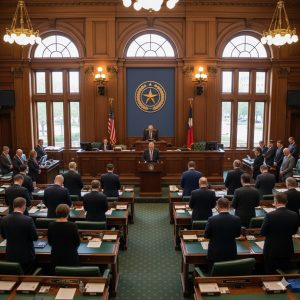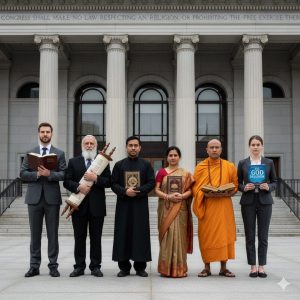

The New Apostolic Reformation (NAR) is a loosely connected Christian movement that seeks to restore modern-day apostles and prophets to leadership positions within the church. While not a formal denomination, NAR adherents believe they are part of a divine movement to reclaim cultural and political spheres for Christ. Many of its leaders advocate for a Dominionist worldview, seeking to bring governments, media, and education under Christian control to usher in God’s kingdom on earth.
Dominionism is a theological and political ideology that promotes the belief that Christians should control civil governance and societal institutions to implement biblical law. While groups of Dominionists differ in strategy and emphasis, the core idea remains that Christian principles should govern all aspects of life, often at the expense of secular governance.
Is the NAR Connected to Dominionism?
Dominionism is deeply embedded within NAR theology, although there are some distinctions we will cover in a moment. Dominionism, also known as “Christian Reconstructionism”, is the belief that Christians are mandated to take control of societal structures and implement biblical governance. NAR is a type of Dominionism, and it is one of many ideologies under the Dominionist umbrella. The NAR concept of the Seven Mountain Mandate (which includes dominating Government, Media, Education, Economy, Religion, Family, and Entertainment) is a direct strategy for achieving dominion, making NAR one of the most politically active religious movements in America today.
Dominionism’s Strategies and Impact
- Legislative Influence: Dominionist figures have pushed for policies aligning with biblical values, such as restricting abortion, opposing LGBTQ+ rights, and implementing religious education in public schools.
- Christian Nationalism: Many Dominionists explain the importance of their movement as a way to restore America to its supposed “Christian roots,” advocating policies that favor conservative Christian values over religious pluralism and secular humanism.
- Charismatic Leadership: The influence of modern “prophets” and “apostles” within NAR extends beyond church walls into business, education, and politics.
A Distinction, But With a Common Political Goal
Although the NAR and it parent ideology Dominionism share dominion ideas in politics, their leaders do not collaborate on a regular basis because of their theological differences. Here are some of the most influential individuals from both movements:
NAR Leaders (Charismatic-Pentecostal)
- C. Peter Wagner (1930 – 2016) Founder of NAR, was a former missionary turned church-growth specialist who believed in the restoration of apostles and prophets to govern the church and nation.
- Bill Johnson (1951 – ) Senior Pastor of Bethel Church, promotes supernatural miracles and healing revival as signs of God’s kingdom advancing.
- Lance Wallnau (1955 – ) teaches the Seven Mountain Mandate, arguing that Christians must influence culture to bring about God’s reign.
Dominionist Leaders (Calvinist-Reconstructionist)
- R.J. Rushdoony (1916 – 2001) The father of Reconstructionism, he rejected Pentecostalism and instead focused on biblical law as the standard for government.
- Gary North (1942 – 2022) promoted economic theocracy and the eventual dismantling of democracy and secular government in favor of Christian theocratic rule.
- Greg Bahnsen (1948 – 1995) argued for the application of Old Testament law, including capital punishment for biblical crimes in today’s legal system.
Key Theological Conflicts
- Prophetic Authority vs. Scriptural Authority – NAR emphasizes modern prophetic revelation, while Dominionists adhere to strict biblical law and reject new revelations.
- Miracles vs. Theonomy – NAR believes in miraculous signs and wonders, whereas Dominionism focuses on legal frameworks and societal control.
- Spiritual Warfare vs. Political Reconstruction – NAR seeks to defeat demonic forces in high places and influence culture (concerns of a “Deep State”), while Reconstructionists seek to restructure society directly through law and governance, bypassing due processes.
Despite these theological differences, many Dominionist thinkers have found common ground with NAR leaders in Christian Nationalist efforts.
Theological Conflicts Between Pentecostal-Charismatics and Calvinist-Reconstructionists
Pentecostal-Charismatics (NAR) and Calvinist-Reconstructionists (Dominionism) have historically distrusted each other due to major theological differences, especially on Divine Revelation. Calvinist-Reconstructionists adhere to sola scriptura, rejecting ongoing prophecy and supernatural manifestations, whereas NAR leaders emphasize modern-day apostles, prophetic visions, and miracles. This divide was amplified by John MacArthur’s Strange Fire conference, which labeled Charismatic-Pentecostal practices as heretical. Additionally, Reconstructionists prioritize strict biblical law and structured governance, while NAR leaders favor fluid, Spirit-led authority, seeing governance as divinely ordained through prophetic leadership. Their eschatological divide further deepens the conflict: Calvinists generally believe in postmillennial dominion through legal and societal transformation, whereas NAR promotes rapid supernatural revival as a precursor to Christ’s return.
Collaboration Despite Distrust
Despite these theological disagreements, both groups have increased their collaboration on Christian Nationalism due to their shared desire to see the U.S. governed by Christian principles. They are more than happy to unite politically to oppose secular policies, support Christian-friendly legislation, and influence elections. Movements such as the ReAwaken America Tour blend Charismatic revivalism with Reconstructionist legalism, demonstrating an alliance despite their deep doctrinal tensions, due to pragmatic concerns. This collaboration shows how a common political vision can bridge theological divides, even between groups that historically viewed each other with distrust.
How Are the NAR and Dominionism Working Together Today?
While theological divisions remain, both movements have increasingly collaborated in political activism, especially in the U.S.
Recent Examples of NAR-Dominionist Alliances
- Lance Wallnau (NAR) & Christian Nationalists: Wallnau’s Seven Mountain Mandate has been embraced by some Dominionists who see it as a strategy for theocratic governance.
- ReAwaken America Tour: A movement blending NAR-style charismatic revivalism with Dominionist legal strategies, featuring figures from both sides.
- Political Influence: Both movements support a Christian restoration in government leadership, despite theological differences.
Key Quotes from Dominionist and NAR Leaders
- Gary North (Reconstructionist Theologian):
“We must use the doctrine of religious liberty to gain independence for Christian schools until we train up a generation of people who know that there is no religious neutrality, no neutral law, no neutral education, and no neutral civil government. Then they will get busy in constructing a Bible-based social, political, and religious order which finally denies the religious liberty of the enemies of God.” (Political Polytheism, 1989)
- R.J. Rushdoony (Founder of Christian Reconstructionism):
“In colonial New England, the covenantal concept of church and state was applied. Everyone went to church, but only a limited number had voting rights in the church and therefore in the state, because there was a coincidence of church membership and citizenship. The others were no less believers, but the belief was that only the responsible must be given responsibility. One faith, one law, and one standard of justice did not mean democracy. The heresy of democracy has since then worked havoc in church and state, and it has worked towards reducing society to anarchy.” (Institutes of Biblical Law, 1973)
- Lance Wallnau (NAR Leader and Seven Mountain Advocate):
“Every Christian should be a Christian Nationalist when it comes to the choice between one-world globalism and their own sovereign nation. If we Christians all succeeded, the world would look like heaven on earth. And this isn’t my opinion; it’s the plan God has whether you and I like it or not––it’s called the Millenium. Ought we not be praying and acting in accordance with what ‘thy kingdom come thy will be done’ looks like?” (Are You a Christian Nationalist? Web blog, 2022)
A 19th Century Warning from Ellen G. White
Seventh-day Adventists consider Ellen G. White (1827-1915) a significant religious figure and someone with prophetic authority whose writings offer insights into Christian faith, morality, and eschatology. She was instrumental in the organization of the Adventist movement and provided extensive commentary on religious liberty.
Mrs. White warned about the National Reform Movement (NRM) of the 19th century, a religious-political effort to amend the U.S. Constitution to establish Christianity as the national religion. Her warning remains relevant as today as ever as the NAR echoes many of the same principles today:
“The National Reform movement, exercising the power of religious legislation, will, when fully developed, manifest the same intolerance and oppression that have prevailed in past ages. Human councils then assumed the prerogatives of Deity, crushing under their despotic power liberty of conscience; and imprisonment, exile, and death followed for those who opposed their dictates.” — Testimonies, Vol. 5, p. 712
This prophecy highlights the dangers of merging state power with religious dogma. It is a solemn reminder that when Christianity is enforced through legislation rather than invitation, it leads to coercion, persecution, and the loss of religious freedom.
The National Reform Movement: A Historical Parallel From the 1880’s
The National Reform Movement (NRM) sought to legally establish Christianity as the basis for U.S. law. Their objectives included:
- Amending the U.S. Constitution to recognize Jesus Christ as the nation’s ruler.
- Enforcing Christian moral laws, such as Sunday observance and blasphemy laws.
- Suppressing religious minorities, including non-Protestant groups and non-believers.
Comparing NRM, NAR, and Dominionism
| Feature | National Reform Movement (Late 19th Century) | New Apostolic Reformation (1990’s to the Present) | Dominionism (1960’s to the Present) |
| Theocratic Goals | Sought to amend the U.S. Constitution to establish a Christian Nation. | Advocates for Dominion Theology, aiming for Christian control over all aspects of society. | Seeks to eliminate secular governance and replace it with “biblical” rule. |
| Church & State | Wanted direct government enforcement of Christian moral laws. | Prefers using political influence rather than direct legal changes. | Argues that civil law should reflect “biblical” law. |
An Invitation to True Evangelism: Let’s Share Jesus, Not Impose Him
Many Christians today fear the growing secularization of society. They worry that moral relativism and anti-Christian policies will erase Christianity from public life. These concerns are valid, and the Bible speaks about the increase of lawlessness and hostility toward faith in the last days.
However, history and prophecy warn against responding with force, legislation, or coercion. He could have led a powerful political and military revolt against Roman rule, but He did not. Jesus never commanded His followers to seize power through the state. Instead, He called them to be lights in the world (Matthew 5:14), transforming hearts through love, truth, and invitation. He was emphatic that His kingdom is “…not of this world.” (John 18:36)
We are to invite all believers to share Jesus through invitation, not through political coercion, cultural bullying or legal force. Let us reflect His love, grace, and truth in our communities, leading others to Him by example, rather than by force.
“Come unto me, all ye that labor and are heavy laden, and I will give you rest.” — Matthew 11:28
The American Sentry would like to humbly invite our fellow Christian brothers and sisters to follow in the example of Jesus, our meek and lowly Savior. Let us take this as our mission—not to build an earthly theocracy but to bring people to Christ’s Kingdom, which is not of this world, through love, humility, and faithfulness.