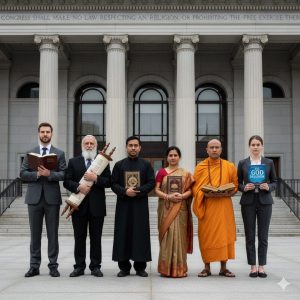

The First Amendment of the United States Constitution, with its Establishment Clause and Free Exercise Clause, lays the groundwork for a society where religious liberty is supposed to thrive. Yet a higher authority, the Bible itself, reveals that a proper Christian understanding of these principles can be articulated through the following Biblical examples:
- The Golden Rule
- The acknowledgment that Christ’s Kingdom is not of this world
- The exhortation to render unto Caesar that which is Caesar’s
- Paul’s address on Mars’ Hill
These foundational elements support a compelling case for religious liberty that honors the beliefs of all individuals.
The Golden Rule: A Principle of Mutual Respect
At the heart of Jesus’ teachings lies the Golden Rule: “Do unto others as you would have them do unto you” (Matthew 7:12). This principle establishes a framework for interpersonal relationships that transcends individual faith traditions. If Christians desire the freedom to practice their faith without interference, they must extend that same respect to others. This reciprocity creates an environment where diverse beliefs can coexist peacefully. Upholding the Golden Rule naturally leads to advocating for the rights of all, emphasizing that every person’s conscience is sacred and deserving of protection, as we accord unto others what we expect to be accorded to ourselves.
Christ’s Kingdom is Not of This World
In John 18:36, Jesus states, “My kingdom is not of this world.” This assertion implies that the realm of faith transcends earthly governance and structures. As Christians, we recognize that true allegiance belongs to God’s Kingdom, which is characterized by love, grace, and voluntary commitment, and it is a Kingdom not of this world. This understanding liberates us from the temptation to impose our beliefs through political power or cultural dominance. Instead, we are called to witness for our faith in a way that invites rather than coerces, allowing for a rich diversity of beliefs to flourish within the civil sphere.
Render Unto Caesar
In Matthew 22:21, Jesus teaches, “Render to Caesar the things that are Caesar’s, and to God the things that are God’s.” This statement delineates the responsibilities of earthly governance while affirming that ultimate authority belongs to God. It provides a framework for Christians to engage with civil society while respecting its distinct role. By acknowledging the legitimacy of governmental authority, Christians can advocate for laws and policies that protect religious liberty for all, ensuring that no single faith, including Christianity, is privileged over others. This balance fosters a pluralistic society where diverse beliefs coexist and operate under a common legal framework.
Paul’s Speech on Mars’ Hill
In Acts 17:16-34, Paul addresses the Areopagus in Athens, recognizing the religious diversity of the city. He engages with the Athenians on their terms, acknowledging their many altars and even quoting their poets. By affirming the search for the divine inherent in all people, he demonstrates respect for differing beliefs while proclaiming the truth of Christ. This example highlights the importance of dialogue and understanding in a pluralistic society. Christians are called to engage with others respectfully, acknowledging the validity of their search for meaning while sharing the hope found in the Gospel.
Conclusion
In light of the Golden Rule, the acknowledgment that Christ’s Kingdom is not of this world, the call to render unto Caesar, and Paul’s address on Mars’ Hill, we see a clear biblical mandate for religious liberty and pluralism in the civil sphere. These principles encourage an earthly society where individuals of all faiths can coexist, practice their beliefs freely, and engage in meaningful dialogue. Upholding the protections of the First Amendment is not just a legal obligation but a Biblical one; it is a reflection of Christ’s love and respect for every individual’s conscience. By embracing this informed pluralistic approach, Christians can contribute to a culture that values and honors the diverse beliefs of all its members, ultimately reflecting the heart of the Gospel in the public square. But exemplifying this Biblical ideal, we will be opening hearts and minds to the sacred truths of the Everlasting Gospel of Peace.